
What Is a Prolapse? And What That Pressure, Bulge, or Weird Feeling Really Means
Let’s be honest — the word prolapse is giving… ick. It conjures up imagery of body parts drooping or hanging out of places they shouldn’t. Maybe you heard it in a doctor’s office, maybe you Googled your symptoms at 3 a.m., or maybe a friend whispered it in fear like it was some sort of pelvic floor voodoo.
Wherever you first encountered it, I’m here to tell you: prolapse isn’t the end of your vagina. You’re not broken, you’re not alone, and no — your bits aren’t about to fall out like loose change from a hole in your pocket.
So let’s talk about it. Let’s get real clear about what a prolapse actually is — and what it definitely isn’t.
Your Pelvic Organs 101
Before we dive into “what is a prolapse”, let’s do a quick tour of your undercarriage — pelvic edition.
Inside your pelvis live three superstar organs:
The bladder (in the front),
The uterus (in the middle), and
The rectum (in the back).
They’re snugly supported by your pelvic floor muscles — a sling or hammock of muscle and connective tissue stretching from your pubic bone to your tailbone. Think of your pelvic floor like a bouncer at an exclusive club, keeping things in their rightful places and making sure everyone behaves.
These muscles do a LOT. They support your organs, help you stay dry when you sneeze, stabilize your core, and make sex feel good. But like any part of the body, they can get tired, overstretched, or injured.
What happens when that support system weakens? That’s when we enter prolapse territory.
Here’s the thing: pelvic organ prolapse is super common. We’re talking up to 50% of people with vaginas will experience some degree of it in their lifetime — especially after childbirth, during perimenopause, or later in life.
And yet we have the same old story with women’s health issues… nobody talks about it. So let’s talk about it.
What Is a Prolapse?
A pelvic organ prolapse (aka POP), happens when one (or more) of those pelvic organs shifts downward or presses into the vaginal wall because the muscles and connective tissue holding them up aren’t quite doing their job.
This doesn’t mean organs are falling out of your body. It means they’ve lost some support and are leaning a little too close to the exit.
There are a few types of prolapse, depending on which organ is playing peekaboo:
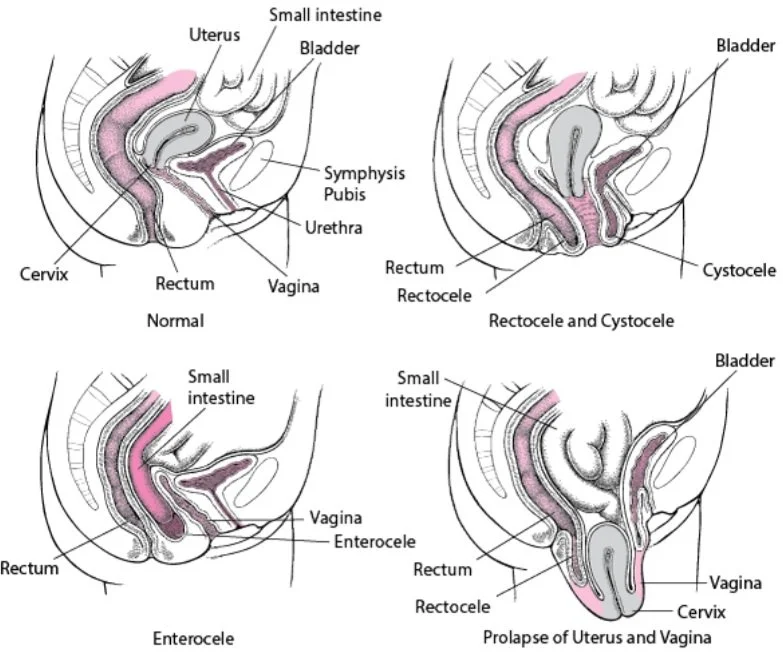
Pelvic Organ Prolapse: Merk Manuals
Cystocele (bladder): The bladder bulges into the front, or anterior wall of the vagina. You might feel like you have trouble fully emptying your bladder.
Rectocele (rectum): The rectum pushes into the back, or posterior wall of the vagina. It can worsen with constipation and can feel like you can’t completely empty your bowels.
Uterine prolapse: The uterus drops downward into the vaginal space — sometimes even to the opening where you may be able to visualize your cervix with a mirror.
Enterocele: The small intestine pushes into the top/back of the vagina. Less common, but still part of the prolapse crew.
With any of the above, there can be a feeling of bulging, like something is in your vagina (like a tampon) when there isn’t, or heaviness and pressure.
How Do You Know If You Have One?
Okay so now we know, what IS a prolapse, but how do you know if you have one? Prolapse isn’t always visible or dramatic. In fact, many women walk around with a mild prolapse for years before realizing what’s going on, and some may actually never notice it.
Some classic symptoms include:
A feeling of heaviness, pressure, or dragging in your pelvis
Feeling like there’s a bulge or something “in the way” down there when you wipe on the toilet
Difficulty inserting a tampon or it feeling like it won’t stay in/ is being pushed out
Changes in how you pee — like incomplete emptying
Poop problems — like feeling your stool is stuck, needing to splint (press on the perineum or vaginal wall while pooping), or like you can’t get it all out
Symptoms that get worse at the end of the day, after standing for long periods, after exercise or with heavy lifting
How Do We Know How Advanced A Prolapse Is?
There are a few different methods that a pelvic physio could use to “grade” a prolapse, including the Baden-Walker system which is a quicker, simpler method of measuring. However, most commonly used in clinic and research is the POP-Q due to it’s reliability and specificity.
Your physiotherapist or doctor could use either method when you are examined so let’s have a quick look at both.
Baden-Walker System:
Grade 0: Normal position, no prolapse.
Grade 1: Prolapse descent is halfway to the hymen.
Grade 2: Prolapse descent is to or at the hymen.
Grade 3: Prolapse descent is halfway past the hymen.
Grade 4: Maximal possible descent.
POP-Q System:
Stage 0: No prolapse.
Stage I: Prolapse is more than 1 cm above the hymen.
Stage II: Prolapse is within 1 cm of the hymen (either above or below).
Stage III: Prolapse is more than 1 cm below the hymen but protrudes no farther than 2 cm less than the total vaginal length.
Stage IV: Complete eversion of the lower genital tract.
But here’s the kicker: symptoms don’t always match severity.
Someone with a “stage 1” prolapse (mild) might feel tons of discomfort, while someone with a “stage 3” might barely notice. Every body is different.
That’s why a proper pelvic floor assessment is key — because you deserve clarity as to what’s going on down there and how best to manage it, reduce your symptoms and stop it from becoming worse.
The way that a prolapse can affect your comfort and your life are what’s most important here.
Regardless of your grade or stage of prolapse, the focus will always be on managing your symptoms because the prolapse in itself isn’t dangerous.
Is it scary? Maybe initially. Life-ruining? Not even close.
You’re Not Broken (And You’re Definitely Not Alone)
Let’s bust some myths while we’re here:
Myth: Prolapse only happens to older women.
Truth: It can happen at any age — even in your 20s or 30s, especially after childbirth.Myth: Once you have prolapse, your vagina is ruined.
Truth: Nope. Your vagina is still beautiful, functional, and worthy of love and care.Myth: We can see your bladder or rectum inside your vagina when we assess for rectocele or cystocele.
Truth: Your vaginal wall is the only tissue we are seeing when we assess for those types of prolapse. Either the front wall or the back wall is bowing in - we can’t see your literal bladder, rectum or the poop inside it.Myth: You’ll need surgery.
Truth: Most prolapses can be managed conservatively — with pelvic physio, pessaries, and lifestyle changes.Myth: You can’t lift weights or have sex anymore.
Truth: With the right support, education and lifestyle management - you can definitely continue to do both — safely and confidently.
Prolapse can feel like a betrayal of your body — especially if you’ve had kids, gone through menopause, currently in perimenopause or simply weren’t told this was even a possibility. You might feel frustrated, embarrassed, or like your body is falling apart.
You’re allowed to feel all of that. But I’m here to tell you: your body is not broken. It’s just asking for backup and guidance.
There is so much that can be done to help manage your prolapse and individual symptoms. Sometimes, a few quick changes in how you exercise or move can make a largely impactful improvement. Other times, it can be simple as using a new product to help support those tissues. When we find your perfect combination is when you start feeling like yourself again.
You deserve to be informed, supported, and not terrified every time you Google your symptoms. And you 100% deserve healthcare that meets you where you are — without shame, without fear, and definitely without the phrase “just live with it.”
This Is Just the Beginning
Prolapse is one chapter in your pelvic health story — not the whole book.
In the next posts in this series, we’ll dig into:
What causes prolapse (spoiler: it’s not just babies)
What you can do to feel better (no surgery required)
How to live your full, fabulous life with prolapse in the passenger seat — not the driver’s
Got questions? Feel confused, worried, or just want to scream into the void? Come talk to me. Hive Pelvic Health is here to support your hive — your whole self — with knowledge, compassion, and zero judgment.
And if you’re ready to feel like yourself again, book a pelvic floor assessment. I’ll bring the expertise, you bring the badassery.
Here for you and your hive,
Laine
-
Louise Carroll, Cliona O’ Sullivan, Catherine Doody, Carla Perrotta, Brona Fullen. PLoS One. 2022 Nov 2;17(11):e0276788. doi: 10.1371/journal.pone.0276788. Pelvic organ prolapse: The lived experience.
POP-Q. Pelvic Organ Prolapse interactive assessment tool. American Urogynecologic Society | AUGS
About the Author: Laine Wall

Hey Babe! Thanks for stopping by the Hive blog.
I am a Registered Pelvic Physiotherapist focusing on women’s health and perinatal and postpartum health. I love supporting women on their individualized pelvic health journey.
I am the owner and founder of a pelvic physiotherapy clinic called Hive Pelvic Health in Millbrook, Ontario, also offering virtual appointments for those residing anywhere in Ontario, Canada.
Have more questions? Get in touch with me.
Hive Pelvic Health is located in the township of Cavan-Monaghan, in Peterborough County. It is less than 20 minutes from Peterborough and 30 minutes from Durham region.
GET ON THE EMAIL LIST
Be the first to get the newest blog post straight to your email and to hear about other mother-loving resources.
